The other week I noticed that a favorite pair of shoes—my black leather high tops—were not going to make it.
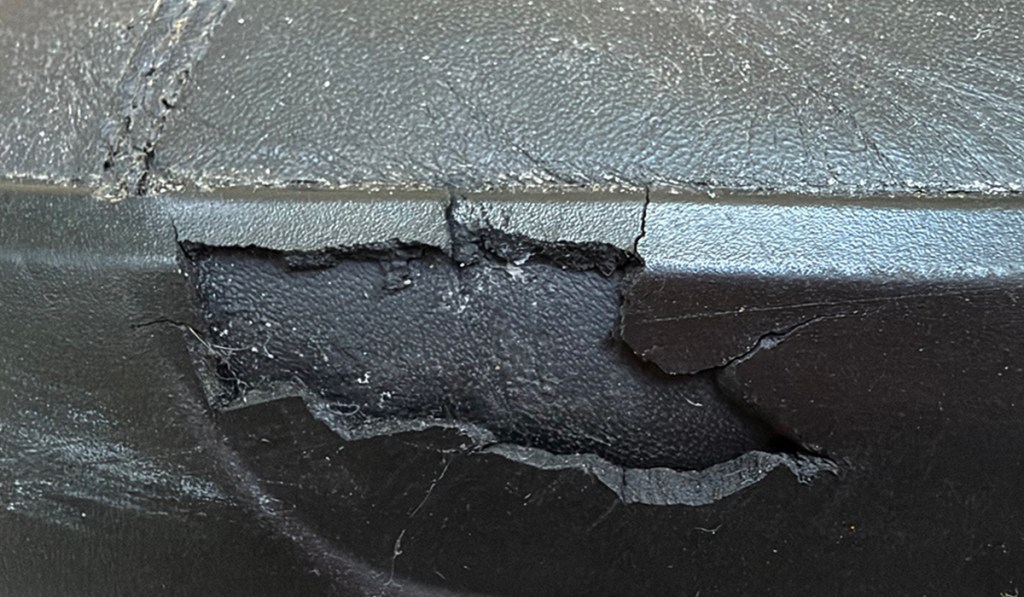
I had bought them around nine years ago. And though I only wore them in the fall and winter, their soles were worn down and about to detach, and their rands were starting to crack, peel, and break off in pieces.
Time to get a new pair.
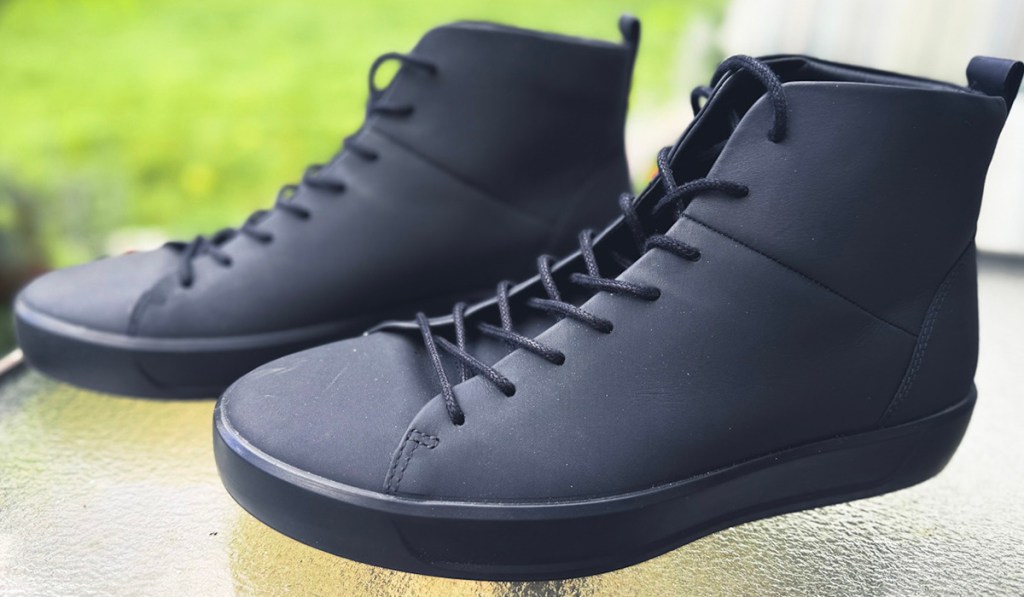
Unfortunately, but not unexpectedly, they’re no longer made. The company is still around, but foolishly they had stopped making what was obviously one of their best designed shoes. They are comfy sneakers but look a bit more like casual shoes, modern but not in a ridiculous way, minimalist but not boring, distinctive but not aggressively so, no overt exterior branding.
I shopped around for alternatives but none was just right.
My wife suggested I check out used clothing sites. I was skeptical. My shoes were used. That was the problem. What was the likelihood of finding a used pair of shoes last made maybe seven years ago in better condition than the ones I had? And would I want to wear shoes someone else had been wearing for that long anyway?
Nonetheless, I looked. And much to my surprise, I found a pair, quite possibly the only remaining pair for sale on earth that met the following criteria: the exact same make and model as my shoes, (seemingly) never worn, my size. Even more to my surprise, I found them for sale on Craigslist.
I hadn’t bought anything off of Craigslist in… the entire history of the universe? At least I couldn’t remember doing so. How does one even buy stuff off of Craigslist? The seller, a man named Rob, lives in Minnesota, near Minneapolis; I live in South Carolina. It’s not like we could meet in a parking lot somewhere to complete the deal. Nonetheless, I wrote to him.
Me: Hi Rob – I’m writing about the black leather shoes you have for sale on Craigslist. Are they still available? Thanks.
I have sold things over Facebook marketplace, and one of the annoying things about doing so is that you may get tons of automated bot (or bot-like) messages asking if whatever you’re selling is still available, followed by no follow-up whatsoever. So I wasn’t surprised when I initially didn’t hear anything back from Rob. But then I did.
Rob: Yes
Amazing. Now for the hard part: asking about shipping while also haggling over the price. He wanted $180 for the shoes. That seemed like a lot. I don’t recall paying that much for them—I must have originally gotten them on sale.
The Craigslist ad had been up for almost a month, so I figured I could lowball him a little.
Me: Would you take $150 for them, including shipping them to me in South Carolina?
Now there was another pause, much longer than the one between my initial message and his terse response. After a while I began to think I had asked too much.
But it was worse than I thought.
Rob: Tell you what Justin, why don’t you come up here instead and pick ’em up for $200?
Oh no. This guy either doesn’t understand haggling or is a bit of a, uh, hmm, let’s say quick-tempered gentleman. I had to rescue the possibility of buying the shoes, but without losing too much negotiating leverage. Maybe some mild humor would work?
Me: Do you have a counteroffer that involves shipping? I don’t think I have time to come up to Minnesota, alas.
Another long pause. Is he looking up shipping rates? Ignoring me? Nope. Again, worse:
Rob: Dude, please stop. I know this is a scam. Have a nice day.
What? I’m not a scammer! (Is running a scam for out-of-production men’s footwear a thing?) He is going to block me. I’m going to lose out on buying the only remaining unworn pair of these shoes for sale in the whole world. Got to act fast. This might hurt my negotiating position, but:
Me: Not a scam. I have these shoes, but one of mine is damaged (see photo), and I’m looking to replace them.
And then I took and sent him a photo of my damaged shoe.
That helped considerably, for the next thing he said was:
Rob: Okay. So how about I’ll take $150 and you pay for shipping?
Further haggling seemed risky at that point so I accepted the deal:
Me: Fair. No need for rush shipping. I haven’t bought anything off of Craigslist in forever. How should the transaction proceed?
Various other sites handle transactions between buyers and sellers, with measures in place to make sure both parties to the transaction do their part and don’t scam each other, or insure the transaction in some way, but not Craigslist. Rob wasn’t sure what to do.
Rob: Shit if I know since I don’t deal with anything non-local. I guess I could pack it up and get a quote from the UPS store and let you know the shipping cost. If all good, Venmo would work for me.
Wait, so I send him money and I’m just supposed to believe that he’ll actually then ship me the shoes? Is he trying to scam me? Now I’m the suspicious one.
Me: Well – and I am saying this in a friendly way – the issue now is whether I can trust you to send the shoes if I send you the money first. (I wouldn’t expect you to send me the shoes without getting the money first.) Can I trust you, Rob?
That sounds like a naïve question, but I do think that some people will not want to have lied, and so if they answer “yes” to it, they will feel bound to follow through on what they’re being trusted to do. Still, I thought that perhaps more robustly establishing our identities, for possible accountability purposes, would help, so I sent him a link to my Facebook profile as I awaited his answer.
Rob: Yes you can because I’m old school and still on Craigslist.
Semantically, this should not have reassured me. He is just restating part of the problem—he is on Craigslist—not solving it. And yet, pragmatically, it did the trick, because it was funny. Humor, it seems, can help generate trust.
He also sent along a link to his LinkedIn page and complimented my dog (one of my Facebook profile pictures has me and my dog in it).
Me: Well in that case let’s do this thing.
I gave him my address and we arranged to chat the next day when he had a shipping estimate. Before we signed off for the night, we talked a little more:
Rob: Interesting way to establish trust; always tenuous. Yes, I will see if I can get you the quote tomorrow. Talk to you soon Justin. And apologies for my wariness.
Me: The wariness is understandable. No worries. We are taking this leap together!
And then he followed up to make sure the shoes were my size. Nice.
The next day I see that I’ve gotten a text from Rob saying he’s at the post office, and he has sent me a shipping quote along with his Venmo handle.
Rob: I’ll hang out at the post office for a few minutes before I need to return to work.
I had missed the text when it came in, which was around 10 minutes before I noticed it. I rushed to reply, fearing he thought I’d ghosted him
Me: Sounds good. Hang on.
I Venmo’d him the money, sending a screenshot.
Rob: Yes, I confirm you paid.
He then sends me a photo of the post office he is in with the accompanying note, “waiting in line”. And then another photo of the receipt with the tracking information and cost on it.
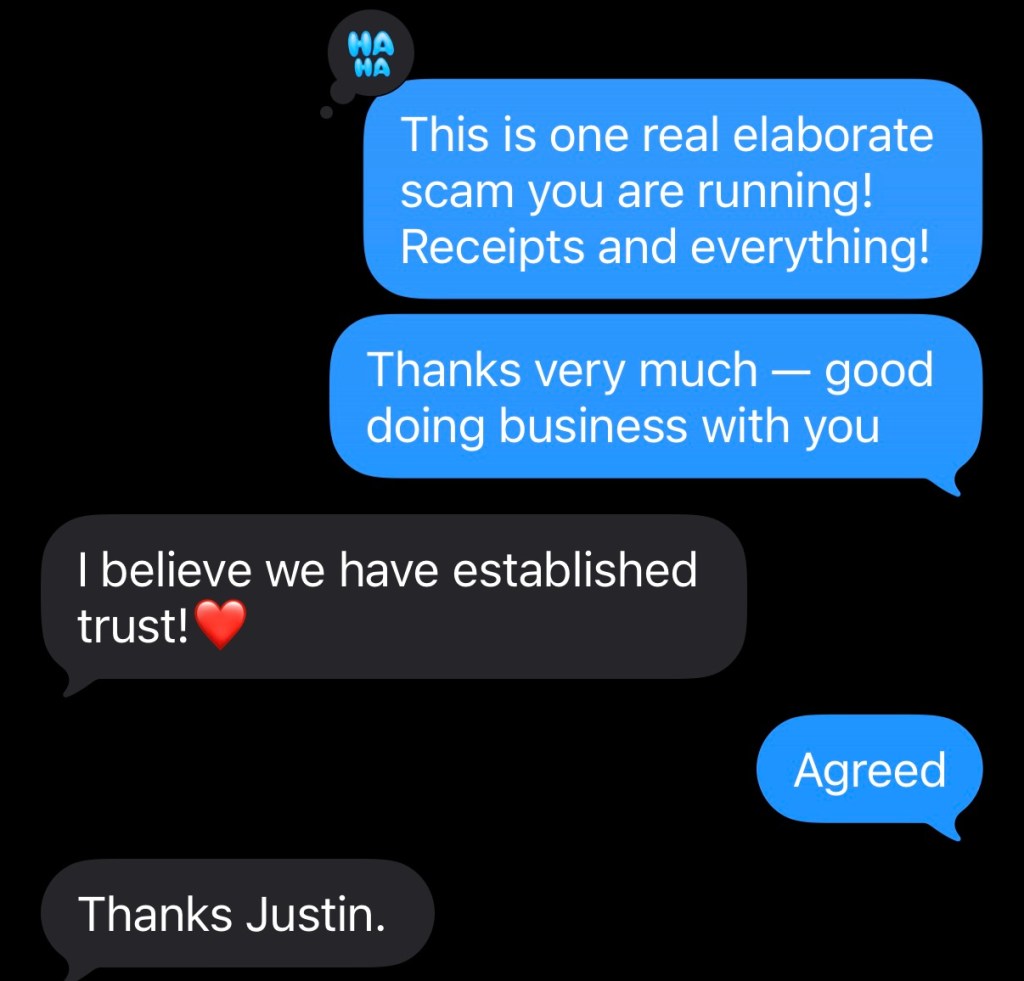
Me: This is one real elaborate scam you are running! Receipts and everything!
I thanked him. Then:
Rob: I believe we have established trust
Me: Agreed
I got the shoes a few days later. They look great. I’ll have to wear them if I ever go to Minneapolis, especially if I have the opportunity to hang out with my new pal, Rob.
Are there some general lessons about trust between strangers to be drawn from this story? I’m not sure—perhaps just some familiar ones about the value of luring out and then appreciating the humanity of the people we’re interacting with—but I wanted to at least have a record of the experience, which was a happy one.












Leave a Reply